Common Good at LEDTEC

Putting responsibility into practice

Business activities have an impact on employees, business partners and the environment. That is why, at LEDTEC, we systematically address the social and environmental aspects of our business activities.

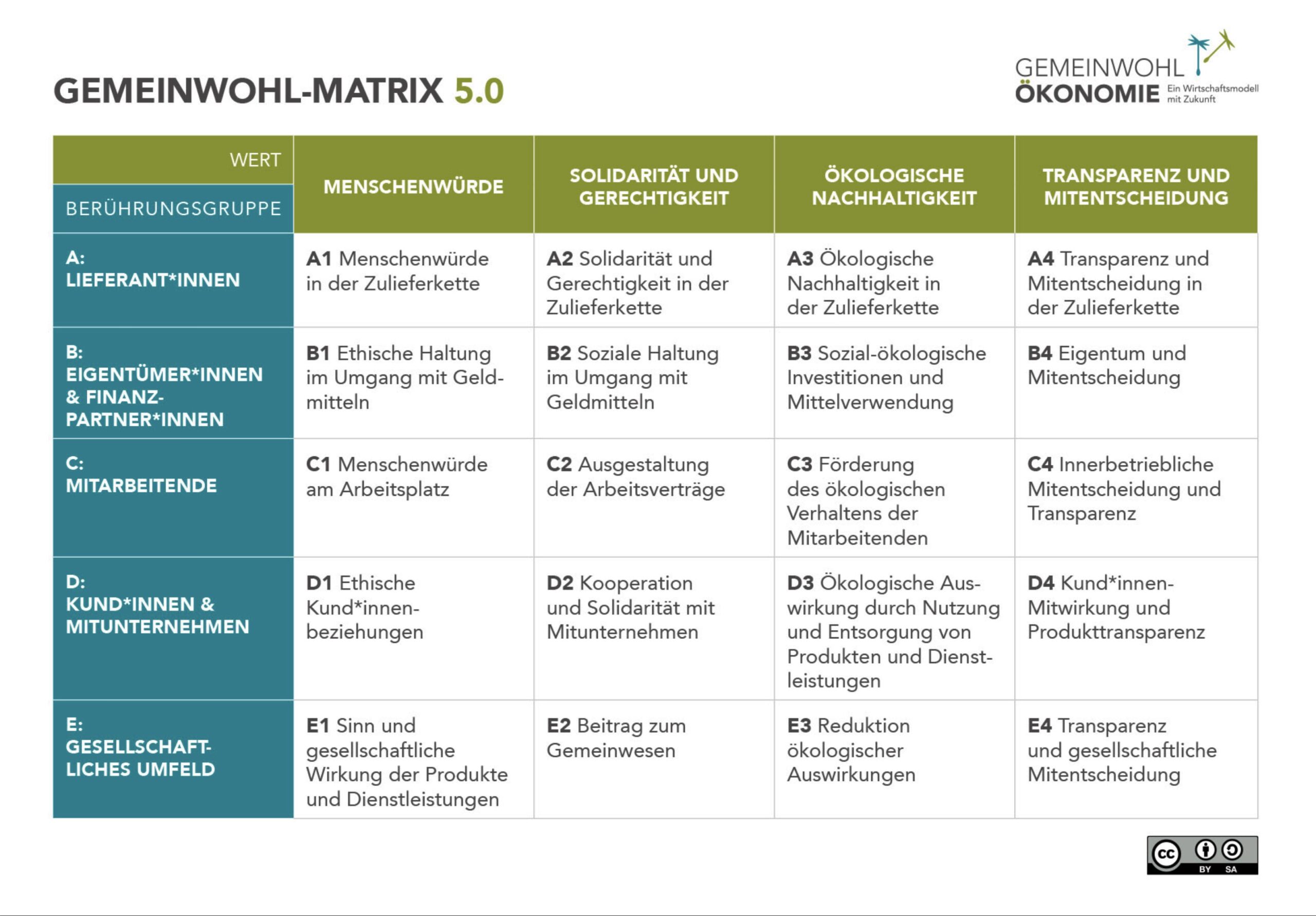
As a framework for orientation, we use, among other things, the areas covered by the Common Good Matrix. They help us examine different aspects of our business activities, assess existing measures and identify further areas for action.

Our focus is not on general promises, but on concrete structures and measures – from working conditions and cooperation with suppliers to our quality and environmental management systems.

What Is the Common Good Economy (ECG)?

The Economy for the Common Good is a values-based economic model that redefines success. Rather than focusing solely on profit, ECG prioritizes human dignity, ecological responsibility, social justice, and transparency. It offers a practical framework for businesses that want to operate ethically and sustainably.

  • Alternative model to traditional capitalism with systemic solutions
  • Rooted in values like fairness, environmental stewardship, and solidarity
  • Designed to address global issues such as inequality and climate change

(Quelle: https://germany.ecogood.org)

Working conditions at LEDTEC

We offer our employees flexible working time models and the option of hybrid working. This provides greater flexibility in balancing different professional and personal requirements.

Employees can also take advantage of individual training and development opportunities. To support employee mobility, we offer a bike leasing scheme. An occupational health management programme is currently being developed.

Our way of working is characterised by short decision-making processes and flat hierarchies.

Cooperation with our suppliers

When selecting and evaluating our suppliers, we consider social and environmental aspects alongside traditional criteria such as quality and reliability of supply.

One of the foundations for this is our Code of Conduct for suppliers and service providers. It sets out our expectations in areas including working conditions and human rights, occupational health and safety, the prohibition of child and forced labour, non-discrimination, anti-corruption measures, and the responsible use of environmental resources.

Our suppliers are regularly assessed according to defined criteria. This includes, among other things, existing management systems and other forms of documented evidence. Certifications according to ISO 9001 and ISO 14001, as well as the results of external social audits, may be taken into account as part of this assessment.

For selected suppliers, particularly in our Asian sourcing markets, we also have access to monitoring results within the framework of amfori BSCI.

This enables us to review different aspects of our supplier relationships in a structured way and incorporate them into our supplier evaluation process.

Quality and environmental management

LEDTEC has maintained certified management systems in accordance with ISO 9001 and ISO 14001 since 2015.

ISO 9001 provides the framework for our quality management system. Through our environmental management system in accordance with ISO 14001, we identify and evaluate relevant environmental aspects of our business activities.

These include, among other things, key figures relating to our operational energy consumption. Consumption data is recorded regularly and evaluated internally. This enables us to monitor developments and identify potential areas for action.

Energy supply at our company site

We also consider the energy supply at our company site as part of our environmental management activities.

We are currently planning a photovoltaic system and a heat pump. Neither measure has yet been implemented. For this reason, we are currently unable to make any statements regarding potential future energy or emission savings.

Once these measures have been implemented and reliable consumption data is available, we will be able to assess their actual impact.

Our approach: concrete rather than general

Social and environmental issues continue to evolve – as do the requirements placed on companies. We therefore do not regard our measures as a completed process.

Our management systems, supplier evaluation processes and the areas covered by the Common Good Matrix provide us with a structured framework.

Our aim is to clearly distinguish between what we have already implemented, what we can substantiate with data or documented evidence, and which areas we are still working on.

In this way, we aim to provide transparent information about the concrete actions we are taking at LEDTEC.